
Introduction
Compressed air systems are often called the fourth utility in industries. They are essential for production, automation, packaging, and many mechanical operations. However, these systems also consume a large amount of electricity. In many plants, compressed air can account for 10% to 30% of total energy consumption.
A professional air energy audit is a detailed evaluation of a compressed air system to identify energy losses, performance issues, and cost-saving opportunities. It is not just about finding leaks. It is a complete system analysis.
Below is a clear step-by-step process of how a professional air energy audit is conducted.
Step 1: Initial Consultation and Data Collection
The process begins with a discussion between the audit team and plant management. The goal is to understand:
Production processes
Operating hours
Current energy bills
Compressor specifications
Maintenance history
The auditors collect basic system information such as:
Compressor capacity (CFM)
Operating pressure (PSI or bar)
Power rating (kW)
Number of compressors
Air dryer and filter details
This step helps auditors understand how the system is designed and how it is currently being used.
Step 2: Site Inspection
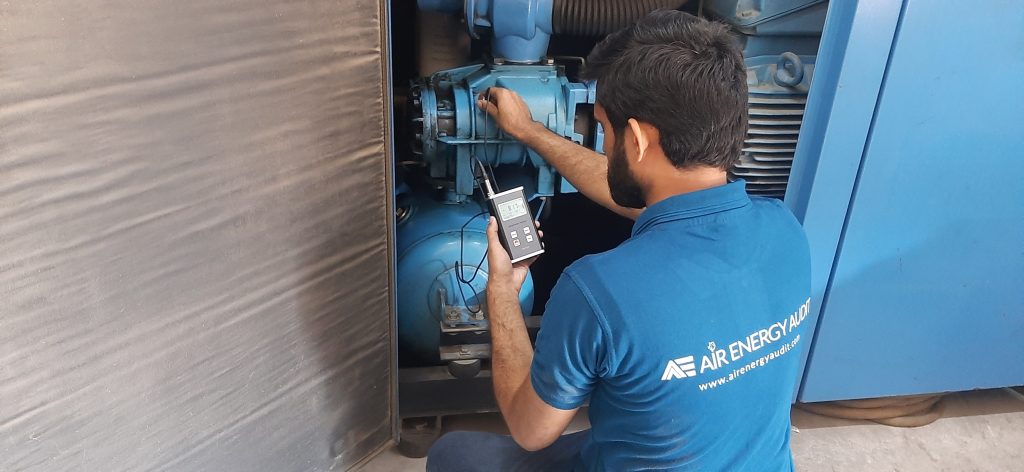
After reviewing documents, auditors visit the facility. They physically inspect:
Compressors
Air receivers
Dryers and filters
Piping network
End-use applications
During inspection, they look for visible leaks, poor piping design, pressure drops, and improper installations.
They also observe how compressors are controlled — whether they operate in load/unload mode, variable speed mode, or cascade control.
Step 3: Installing Monitoring Equipment
Professional audits require accurate measurements. Temporary data loggers and sensors are installed to monitor:
Air flow
System pressure
Power consumption
Temperature
Operating hours
Data is usually recorded for 5 to 14 days to capture real production conditions. Monitoring during both peak and low production periods is important.
Step 4: Measuring Energy Performance
One of the key goals of the audit is to determine system efficiency.
Auditors calculate specific energy consumption (SEC), which shows how much power is used to produce compressed air.
If SEC is high, it indicates inefficiency. Possible reasons include leaks, excessive pressure, or poor compressor control.
Step 5: Leak Detection Survey
Air leaks are one of the biggest sources of energy loss. During the audit, ultrasonic leak detection tools are used to identify leak points in:
Pipe joints
Valves
Quick couplings
Hoses
Air tools
Each leak is tagged, measured, and documented. Auditors estimate the energy cost of each leak and calculate annual financial loss.
Step 6: Pressure Drop Analysis
Pressure drop reduces system efficiency and forces compressors to work harder.
Auditors measure pressure at multiple points in the system — near compressors and at end-use equipment.
If there is a large difference, it means the piping system may be undersized, blocked, or poorly designed.
Reducing pressure drop allows the system to operate at lower overall pressure, which saves energy.
Step 7: Evaluating Artificial Demand
Artificial demand occurs when the system operates at higher pressure than required. For every small increase in pressure, energy consumption increases significantly.
Auditors test whether production can operate at lower pressure safely. Even a small pressure reduction can generate major savings.
Step 8: Analyzing Compressor Controls
Multiple compressor systems often operate inefficiently due to poor sequencing.
Auditors analyze whether compressors are:
Short cycling
Running unloaded for long periods
Operating outside optimal load range
Improper control strategies can waste a large amount of electricity. The audit may recommend installing a master controller or adjusting control settings.
Step 9: Storage Capacity Assessment
Air receivers play an important role in stabilizing pressure.
If storage is insufficient, compressors cycle frequently. This increases wear and energy consumption.
Auditors calculate whether current storage volume matches system demand.
Step 10: Financial Analysis
After collecting technical data, auditors convert findings into financial terms.
They calculate:
Energy wasted due to leaks
Cost of excessive pressure
Savings from control improvements
Return on investment (ROI)
ROI is typically calculated using this formula:
genui{“math_block_widget_always_prefetched”:{“content”:”ROI = (Annual Savings / Investment Cost) × 100%”}}
This helps management understand how quickly improvements will pay back.
Step 11: Detailed Audit Report
At the end of the process, the audit team prepares a comprehensive report.
The report includes:
System overview
Identified problems
Energy performance metrics
Leak summary
Pressure analysis
Financial savings estimate
Recommended improvements
Implementation priority list
Good reports also include short-term, medium-term, and long-term improvement strategies.
Step 12: Implementation Support
Some professional audit providers also support implementation. They may assist in:
Leak repair programs
Control system optimization
Pressure adjustment
Equipment upgrades
Monitoring system installation
Implementation ensures that identified savings are actually achieved.
Why a Professional Audit Is Different from a Basic Inspection
A simple maintenance check focuses only on equipment condition. A professional air energy audit focuses on system performance and energy efficiency.
It uses data logging, financial calculations, and engineering analysis. It connects technical findings with real cost savings.
That is why professional audits often reveal savings between 15% to 35% in compressed air energy consumption.
Conclusion
A professional air energy audit is a structured and data-driven process. It begins with system understanding, moves through detailed measurement and analysis, and ends with financial evaluation and improvement planning.
Instead of guessing where energy is being wasted, industries get clear, measurable answers.
For companies looking to reduce operating costs, improve reliability, and increase energy efficiency, a step-by-step professional air energy audit is one of the most practical and high-impact solutions available.