
A compressed air leak rarely looks expensive.
There is no broken machine, no visible spill, and usually no immediate production stoppage. At most, there is a faint hissing sound coming from a fitting, hose, valve, or pipe connection.
But that small sound represents something much bigger: energy being consumed without doing useful work.
Every minute a compressed air leak remains open, the compressor is being asked to replace air that has already escaped into the atmosphere. Over thousands of operating hours, a leak that seems insignificant can become a surprisingly large operating expense.
The best way to understand the problem is to stop thinking about leaks as maintenance issues and start looking at the numbers.
A Leak Is Really an Energy Loss
A compressor does not produce compressed air for free.
It consumes electricity to compress atmospheric air and deliver it at the required pressure. When that air escapes through a leak, the electricity used to produce it has already been spent.
The compressor then needs to produce additional air to compensate.
The cycle is simple:
Air leak → Additional air demand → More compressor operation → More electricity → Higher operating cost
The U.S. Department of Energy notes that poorly maintained compressed air systems can lose around 20–30% of compressor output through leakage, while proactive leak detection and repair can reduce leakage to below 10% in many systems.
That is why leakage should be treated as an energy-management problem, not just a maintenance problem.
How Much Can One Leak Really Cost?
The answer depends on the leak size, system pressure, compressor efficiency, operating hours, and electricity tariff.
Consider a useful reference point.
DOE data shows that, under its stated assumptions, a 1/8-inch equivalent leak at 100 psig can represent thousands of dollars per year in wasted electricity. Its published examples use specific assumptions for electricity price, compressor efficiency, and continuous operation, so the actual cost at your facility will vary.
The important point is not the exact dollar figure.
It is how quickly the cost increases as the leak gets larger.
A 1/4-inch leak is not simply “twice as bad” as a 1/8-inch leak. Because compressed-air flow through an opening increases significantly with orifice size and pressure, larger leaks can create disproportionately larger losses.
The Formula Behind the Cost
Once the leakage rate has been measured, the annual cost can be estimated using a straightforward relationship:
Annual Leak Cost = Leak Flow (CFM) × Specific Power (kW/CFM) × Operating Hours × Electricity Tariff
For example, if a facility measures a combined leakage rate of 50 CFM, knows its compressor system requires 0.18 kW per CFM, operates for 7,000 hours per year, and pays $0.08 per kWh:
50 × 0.18 × 7,000 × $0.08 = $5,040 per year
That means the facility could be spending approximately $5,040 every year generating compressed air that never reaches production.
And that is from 50 CFM of leakage.
Now imagine the facility has 100 CFM or 200 CFM of combined leakage.
The numbers quickly become difficult to ignore.
DOE guidance similarly uses leakage flow, compressor power requirement, operating hours, and electricity cost to estimate potential savings from leak elimination.
Why Operating Hours Matter So Much
A leak does not care whether production is running.
If the compressed air system remains pressurized during nights, weekends, breaks, or shutdown periods, leaks can continue consuming air.
This is why non-production periods can be particularly useful for identifying hidden losses.
If compressors continue loading when most production equipment is switched off, there may be a significant amount of leakage or other artificial demand in the system.
Monitoring compressor operation during these periods can provide a practical way to estimate leakage in systems with load/unload controls.
Pressure Makes the Problem Worse
Leakage is also affected by system pressure.
As pressure increases, the amount of air escaping through a given opening generally increases. This means operating a system at unnecessarily high pressure can increase leakage as well as compressor energy consumption.
This creates another reason to avoid using excessive pressure simply as a solution to production problems.
If a machine is not receiving adequate pressure, the real issue could be a leak, undersized piping, blocked filtration, restrictive fittings, or excessive pressure drop.
Increasing compressor pressure may hide the problem while increasing energy costs.
Ten Small Leaks Can Be More Important Than One Big Repair
One of the biggest mistakes in leak management is treating every leak equally.
A facility may have dozens of leaks, but they will not all have the same financial impact.
DOE examples show why prioritization matters: a relatively small number of larger leaks can represent the majority of the potential savings.
That means a good leak-management program should identify, measure, rank, repair, and then verify leaks.
Instead of simply creating a long maintenance list, the facility can focus first on the leaks with the highest annual energy cost.
The Cost Goes Beyond Electricity
The electricity wasted by a leak is only part of the problem.
Continuous leakage can increase compressor running time and contribute to additional wear and maintenance. Significant leakage can also reduce available system capacity and contribute to pressure fluctuations that affect pneumatic equipment.
In some facilities, operators may even assume they need another compressor because existing equipment cannot maintain pressure during peak demand.
But if a large percentage of the existing capacity is being consumed by leaks, adding another compressor may simply increase the amount of energy being used to compensate for an avoidable problem.
How Do You Find the Expensive Leaks?
Not every leak is easy to hear, particularly in a noisy industrial environment.
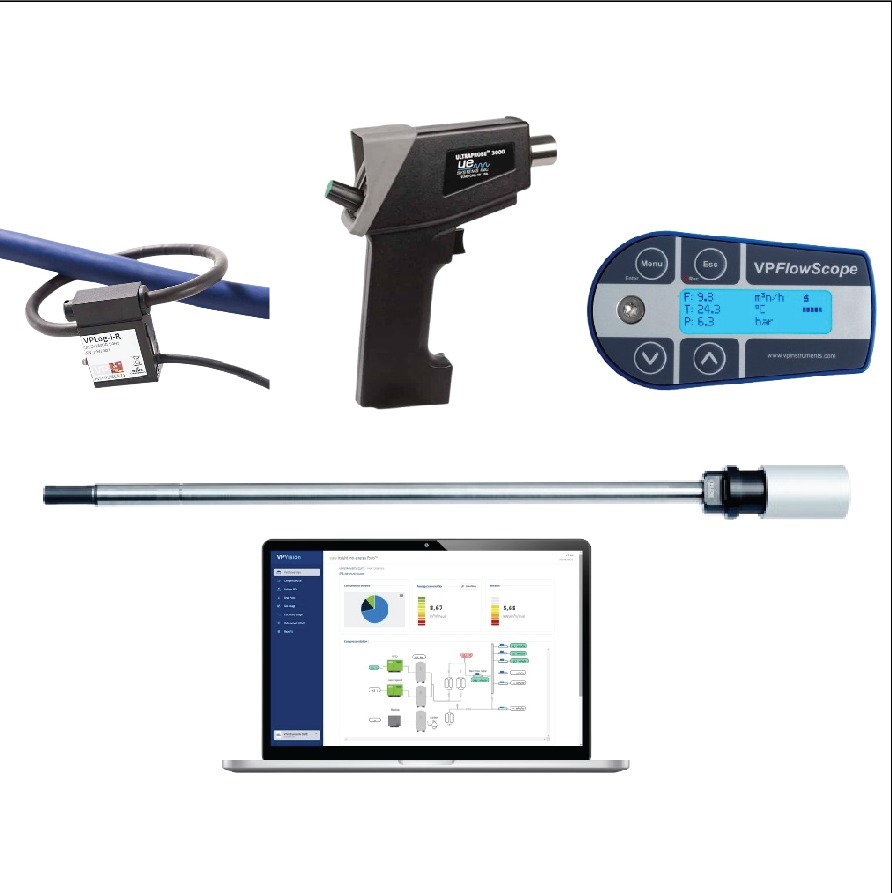
Ultrasonic leak detection is widely used because it can identify the high-frequency sound produced by escaping compressed air and help locate leaks that are difficult to detect by ear.
Once identified, each leak can be recorded and prioritized according to its estimated flow and annual cost.
After repairs are completed, the system should be checked again.
Finding leaks is only half the job.
Verification confirms that the expected savings were actually achieved.
Fixing Leaks Should Become a Continuous Process
Repairing today’s leaks does not guarantee that the system will remain leak-free.
Fittings loosen. Hoses deteriorate. Seals wear out. Valves develop problems. New leaks appear as equipment ages.
That is why effective facilities treat leak management as an ongoing program rather than a one-time survey.
Regular detection, tagging, repair, and verification can keep leakage under control and prevent small problems from becoming expensive energy losses.
The Real Question Is: What Are Your Leaks Costing You?
A compressed air leak may cost only a few dollars a day.
But multiply that by 365 days, several thousand operating hours, and dozens of leaks across a facility, and the annual figure can become substantial.
The good news is that leakage is one of the losses that can be measured and corrected.
You can measure the flow.
You can calculate the energy cost.
You can prioritize the repairs.
And you can verify the savings.
The next time you hear a compressed air leak, don’t just ask, “Can we fix it?”
Ask:
“How much is this leak costing us every year?”
Once you run the numbers, that small hissing sound may suddenly become one of the most important energy-saving opportunities in the plant.