
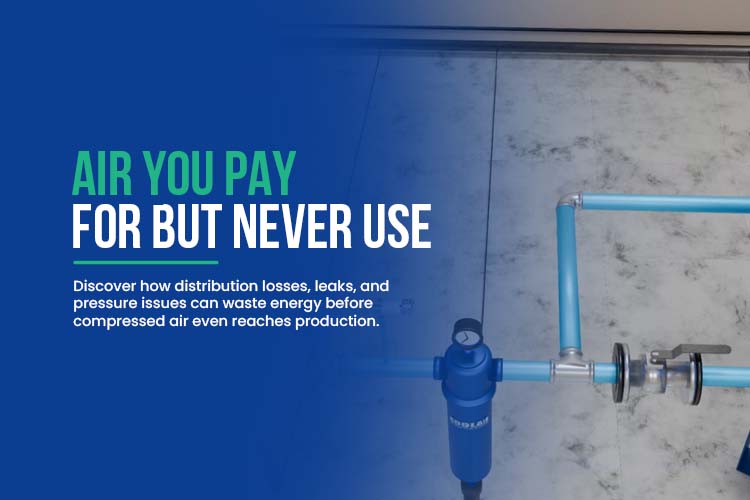
Compressed air is often called the “fourth utility” in industrial facilities. It powers tools, controls machinery, moves materials, supports automation, and keeps production lines running. But there is a hidden problem that many facilities overlook: a significant amount of the compressed air you pay to produce may never reach the point where it is actually needed.
Instead, it can disappear through leaks, pressure losses, inefficient piping, poor system design, and unnecessary demand.
Your compressors continue running. Electricity meters continue counting. Maintenance costs continue adding up. Yet the air you are paying for is simply lost before it contributes anything to production.
Where Does Your Compressed Air Go?
A compressed air system is much more than the compressor itself. It includes dryers, filters, receivers, piping, valves, hoses, fittings, and end-use equipment. Every part of this system can affect how efficiently compressed air reaches production.
One of the most common sources of waste is air leakage.
A small leak may not seem important when you hear it on the factory floor. However, dozens or hundreds of small leaks can create a substantial demand on the compressor system. The compressor must produce additional air to compensate for what is escaping.
This means the facility pays for electricity to compress air that never performs useful work.
Small Leaks Can Become a Big Expense
Compressed air leaks are often found around pipe joints, connectors, hoses, valves, regulators, and pneumatic equipment. Some are easy to hear, while others require ultrasonic leak detection equipment to identify.
The cost depends on factors such as system pressure, leak size, operating hours, and electricity tariff.
For example, imagine a facility operating its compressed air system around the clock. A leak that appears insignificant during a quick inspection can continue for thousands of operating hours every year.
The result is not simply “some lost air.” It becomes lost energy and increased operating cost.
And because leaks often remain unnoticed for long periods, the financial impact can continue month after month.
Pressure Loss Is Another Hidden Problem
Leaks are not the only reason air may fail to reach production efficiently.
Pressure losses throughout the distribution system can force operators to increase compressor discharge pressure just to maintain the required pressure at the point of use.
This can happen because of undersized piping, excessive bends, clogged filters, restrictive fittings, long pipe runs, or poorly designed distribution networks.
The problem creates a cycle:
Higher pressure requirement → More compressor energy → Higher operating cost
If production equipment only needs a certain pressure but the compressor has to operate at a much higher pressure because of distribution losses, the additional energy provides no productive benefit.
In other words, you are paying more to deliver the same result.
Poor Air Quality Can Also Affect Production
Compressed air quality matters as much as pressure and flow.
Moisture, oil, dirt, and other contaminants can enter the compressed air system if filtration and drying equipment are not properly selected or maintained. Contaminated air can damage pneumatic components, reduce equipment reliability, and potentially affect product quality in sensitive applications.
Filters themselves can also become a source of pressure drop when they are not maintained properly.
A filter that is heavily loaded with contaminants may restrict airflow and force the compressor to work harder to maintain system pressure.
Regular maintenance therefore isn’t just about preventing equipment failure. It is also an important part of controlling energy consumption.
Demand-Side Problems Often Go Unnoticed
Another major source of waste is inappropriate use of compressed air.
Compressed air is sometimes used for applications where a simpler and more efficient solution may exist. Examples can include open blowing, cooling, cleaning, agitation, or other processes that continuously consume large quantities of air.
These applications can create artificial demand that keeps compressors operating longer than necessary.
Before increasing compressor capacity, it is worth asking a simple question:
Does production actually need more compressed air, or is the existing air being wasted?
This distinction can prevent unnecessary investment in additional compressor capacity.
Measuring the System Changes Everything
One of the biggest challenges with compressed air efficiency is that waste is not always visible.
A compressor room may look perfectly normal while the system is consuming far more energy than necessary.
That is why measurement and auditing are so important.
A proper compressed air assessment can examine compressor performance, operating pressure, flow demand, specific power, leakage, pressure drop, storage capacity, and equipment operating conditions.
Data can then be used to identify where energy is being consumed and where improvements can deliver the greatest return.
Instead of guessing whether a compressor is oversized or whether a leak is expensive, facility managers can make decisions based on actual operating conditions.
The Goal Isn’t Just More Air — It’s Useful Air
The objective of a compressed air system should never be simply to generate more air.
The real objective is to deliver the required quantity and quality of air at the required pressure, exactly where production needs it, with minimum energy consumption.
That means looking at the entire system rather than focusing only on the compressor.
Fixing leaks, reducing unnecessary pressure, improving piping, maintaining filters, optimizing compressor sequencing, controlling artificial demand, and improving storage can all contribute to a more efficient system.
Stop Paying for Air That Never Reaches Production
Compressed air waste is often treated as an unavoidable operating expense. It doesn’t have to be.
Every cubic foot or cubic metre of compressed air that escapes through a leak represents energy that has already been purchased but provides no production value. Every unnecessary pressure increase and every avoidable restriction can add to the same problem.
The good news is that many compressed air losses can be identified, measured, and corrected.
The first step is understanding where your air is going.
Because the cheapest compressed air is not the air you generate more efficiently — it is the air you stop wasting.