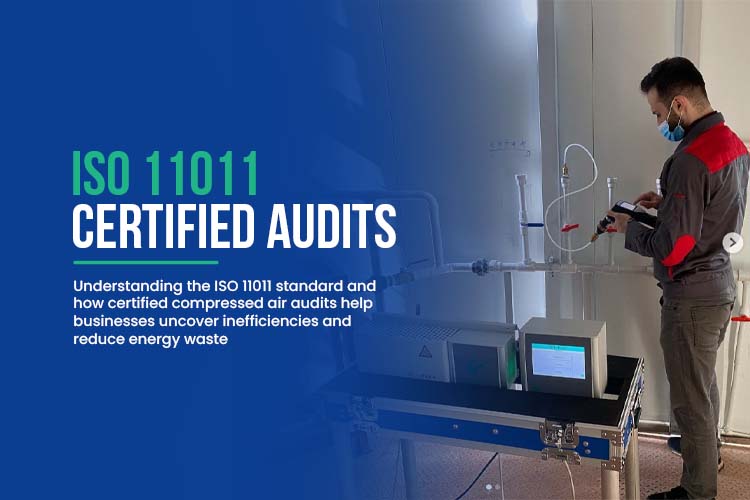
A compressed air audit can reveal leaks, excessive pressure, inefficient compressors, poor distribution, and unnecessary energy consumption. But not every audit is performed in the same way.
This is where ISO 11011 becomes important.
For companies that depend heavily on compressed air, an audit based on an internationally recognized standard provides a structured way to evaluate the entire system rather than simply checking whether the compressors are working properly.
But what does it actually mean when a compressed air audit is described as “certified”?
What Is ISO 11011?
ISO 11011 is an international standard focused specifically on compressed air energy efficiency assessments.
The standard provides guidance for assessing compressed air systems from a system-level perspective. Instead of looking at the compressor as an isolated piece of equipment, it considers the relationship between supply, distribution, and demand.
This is important because a compressor can be operating efficiently while the overall compressed air system is still wasting significant amounts of energy.
An ISO 11011-based assessment helps organizations understand how efficiently the system is producing, distributing, and using compressed air.
Why Looking at the Whole System Matters
A compressed air system typically includes three major areas:
Supply: Compressors, controls, dryers, filters, and air receivers.
Distribution: Piping, valves, fittings, regulators, and connections.
Demand: Pneumatic tools, machinery, production equipment, blowing applications, and other end uses.
Problems in any one of these areas can affect the efficiency of the entire system.
For example, a facility may have a highly efficient compressor, but if the distribution network has excessive pressure drop, the compressor may need to operate at a higher pressure.
Similarly, compressors may be correctly sized, but significant leakage can create artificial demand and cause them to run longer than necessary.
An effective audit therefore needs to consider the complete system.
What Does an ISO 11011 Audit Look At?
An assessment following ISO 11011 principles can examine several important areas of compressed air performance.
These can include:
- Compressor operating conditions
- Compressed air flow and demand
- System pressure
- Pressure fluctuations
- Energy consumption
- Compressor control strategies
- Air leakage
- Storage capacity
- Distribution-system performance
- Air treatment equipment
- End-use applications
- Operating schedules
- Opportunities for energy savings
The objective is not simply to collect numbers.
The measurements are used to understand how the system behaves and where improvements can reduce energy consumption while maintaining the required production performance.
What Does “Certified” Actually Mean?
This is an important distinction.
An audit being described as “ISO 11011 compliant,” “ISO 11011-based,” or “performed according to ISO 11011” does not automatically mean that the audit itself has been certified by ISO.
ISO develops standards; it does not generally certify individual audits or companies itself.
Certification is normally performed by an independent certification body when certification is applicable.
Therefore, businesses should be careful when they see the word “certified.”
A credible audit report should clearly explain the methodology used, the measurements taken, the assumptions made, and the basis for its recommendations.
The value is not simply in putting an ISO number on a report. The value comes from following a structured and technically sound assessment process.
Measurements Are at the Heart of the Audit
One of the biggest advantages of a properly conducted compressed air audit is that it replaces assumptions with actual operating data.
Instead of estimating how much air the facility uses, auditors can measure flow.
Instead of assuming pressure is adequate, pressure can be measured at relevant points.
Instead of guessing whether compressors are operating efficiently, energy consumption can be evaluated against compressed air output.
Leakage can also be investigated to determine how much compressed air is being lost when production demand is low.
This information provides a much stronger foundation for making investment and operational decisions.
An Audit Should Identify More Than Leaks
Compressed air audits are sometimes associated almost entirely with leak detection.
Leak reduction is certainly important, but it is only one part of system optimization.
A complete assessment can uncover opportunities related to compressor sequencing, pressure optimization, storage, piping, air treatment, artificial demand, and end-use equipment.
For example, reducing system pressure may lower energy consumption while also reducing leakage rates.
Improving compressor controls may prevent multiple machines from operating inefficiently at part load.
Increasing or properly positioning storage capacity may help manage fluctuating demand without requiring additional compressor capacity.
These opportunities become easier to identify when the entire system is evaluated together.
Why the Audit Report Matters
A useful audit should not end with a collection of measurements.
The final report should turn those measurements into actionable information.
Ideally, recommendations should explain:
- What problem was identified
- Where the problem occurs
- Why it matters
- What improvement is recommended
- How much energy could potentially be saved
- What investment may be required
- What financial return can be expected
- What should be prioritized first
This allows facility managers to move from technical findings to practical business decisions.
When Should a Facility Consider an Audit?
An ISO 11011-based compressed air assessment can be particularly valuable when a facility experiences increasing energy costs, frequent compressor operation, unstable pressure, unexplained capacity problems, or plans to expand production.
It can also be useful before purchasing additional compressors.
Before investing in more generating capacity, it makes sense to determine whether existing capacity is being lost through leakage, pressure drop, inefficient controls, or unnecessary demand.
In some cases, optimizing the existing system can provide significant benefits without adding another compressor.
The Real Value of an ISO 11011-Based Assessment
The biggest benefit is not the standard itself.
The real benefit is having a structured, measurable approach to understanding compressed air performance.
A properly conducted assessment can help a facility answer critical questions:
How much compressed air are we producing?
How much are we actually using?
How much energy does it take to produce it?
Where are we losing air or pressure?
Which improvements offer the best return?
These answers allow companies to make decisions based on evidence rather than assumptions.
Conclusion
Compressed air is an essential utility in many industrial facilities, but it can also become a significant source of hidden energy costs.
ISO 11011 provides a recognized framework for assessing compressed air systems and understanding their energy performance.
However, organizations should look beyond the word “certified.” What matters most is whether the audit is based on sound methodology, reliable measurements, transparent calculations, and practical recommendations.
A good compressed air audit should do more than tell you that your system has problems.
It should show you where the problems are, how much they are costing, and what you can do about them.
That is where measurement, engineering expertise, and a structured audit methodology can turn compressed air from an uncontrolled operating expense into an opportunity for measurable energy savings.