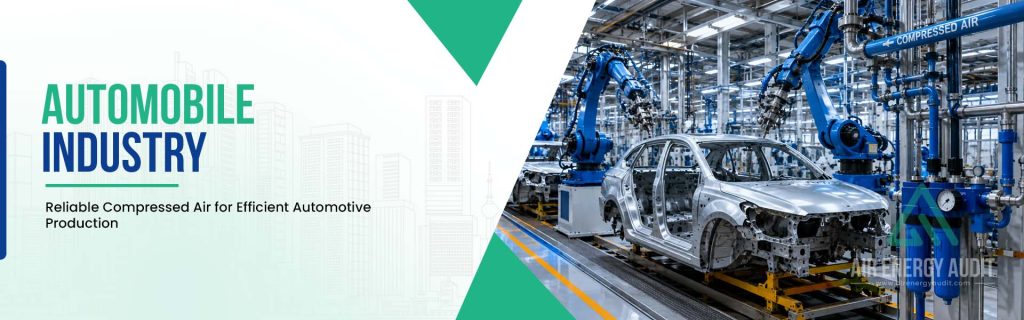
Compressed Air Efficiency in Automobile Manufacturing
The automobile industry relies heavily on compressed air for vehicle assembly, component manufacturing, pneumatic tools, automation, painting, cleaning and material handling.
Air Energy Audit evaluates compressed air systems across automobile manufacturing facilities to identify leakage, pressure losses, inefficient operation and avoidable energy consumption.
Why Compressed Air Matters in Automobile Plants
Compressed air supports many production and assembly operations. Efficient management of the system can help control energy consumption and maintain reliable production performance.
Where Compressed Air Is Used in Automobile Plants
Compressed air is used throughout automobile manufacturing, from component production and assembly to finishing, automation and maintenance.
Vehicle Assembly Lines
Working: Pneumatic tools, actuators and automated equipment support vehicle assembly operations.
Stable air pressure helps maintain consistent equipment performance.
Vehicle AssemblyPneumatic Tools
Working: Air-powered impact tools, drills, grinders and other equipment are commonly used in manufacturing operations.
Optimizing air demand can reduce unnecessary compressor loading.
Production ToolsRobotic Automation
Working: Pneumatic systems support automated machinery, robotic equipment and production-line actuators.
Efficient control air management helps reduce avoidable consumption.
AutomationMetal Fabrication
Working: Compressed air supports cutting, fabrication, machining and other component manufacturing processes.
Proper pressure and flow help pneumatic equipment operate efficiently.
Component ManufacturingPainting & Surface Finishing
Working: Compressed air is used in spray painting and selected surface finishing applications.
Air quality, pressure and flow should match application requirements.
FinishingComponent Testing
Working: Pneumatic systems can support testing equipment and automated inspection processes.
Appropriate pressure control helps avoid unnecessary air consumption.
Testing & InspectionCleaning & Blow-Off
Working: Compressed air is used for cleaning components, machinery and work areas.
Uncontrolled blow-off applications can create significant unnecessary demand.
CleaningMaterial Handling
Working: Pneumatic actuators and systems can assist material movement and automated handling operations.
Efficient air distribution supports reliable operation.
Material HandlingWelding & Production Support
Working: Compressed air can support selected welding equipment, fixtures and production support systems.
Proper air demand management can reduce avoidable consumption.
Production SupportMaintenance Workshops
Working: Air-powered tools and maintenance equipment use compressed air across automobile facilities.
Monitoring workshop demand can help identify unnecessary air usage.
MaintenanceCommon Compressed Air Wastage Areas
Automobile manufacturing facilities can experience energy losses through leaks, excessive pressure, inefficient controls and unnecessary air demand.
Air Leakage
Leaks in piping, fittings, hoses and pneumatic equipment can continuously increase compressor demand.
Excessive Pressure
Higher-than-required pressure can increase energy consumption throughout the compressed air system.
Open Blow-Off
Uncontrolled air used for cleaning and drying can create unnecessary compressed air demand.
Tool & Machine Leaks
Pneumatic tools, machines and connections can develop leaks during continuous production.
Pressure Drop
Restrictions, undersized piping and poor distribution layouts can create pressure losses.
Idle Equipment
Production equipment can continue consuming air during idle periods or reduced production.
Inefficient Controls
Poor compressor sequencing and control settings can result in inefficient system operation.
Artificial Demand
Excessive pressure and inappropriate end-use applications can increase overall air consumption.
Where Energy Is Often Lost
A detailed compressed air assessment can identify avoidable energy losses throughout automobile production and assembly operations.
- Compressor operating inefficiency
- Compressed air leakage
- Unnecessary pressure levels
- Excessive blow-off consumption
- Pressure losses in distribution
- Idle production equipment
- Inefficient compressor controls
- Unoptimized pneumatic tools
Automobile Compressed Air Saving Opportunities
System optimization can help automobile manufacturers reduce unnecessary compressed air consumption and improve overall energy efficiency.
Turning Compressed Air Into Energy Savings
Air Energy Audit evaluates the complete compressed air system rather than focusing only on individual compressors.
The assessment considers generation, treatment, distribution and end-use applications to identify practical efficiency opportunities.
Leakage Reduction
Locate and reduce compressed air leaks throughout the automobile plant.
Pressure Optimization
Identify suitable pressure levels for pneumatic tools and production equipment.
Compressor Control
Review compressor loading, unloading and sequencing performance.
Demand Management
Identify unnecessary air consumption across production and assembly operations.
Tool & Blow-Off Optimization
Evaluate pneumatic tools and blow-off applications for unnecessary air use.
Distribution Improvement
Identify pressure losses and opportunities to improve compressed air distribution.
11011 Compressed Air
Assessment
ISO 11011 Certified Expertise
Air Energy Audit follows the principles of ISO 11011 for evaluating compressed air systems and identifying opportunities to improve system efficiency.
Compressed Air System Assessment
The assessment considers compressed air generation, treatment, distribution and end-use applications.
Measured operating data helps establish a practical understanding of system performance and energy use.
Improving Compressed Air Efficiency in Automobile Manufacturing
An automobile compressed air audit provides a detailed assessment of system performance, energy consumption, pressure, flow and production-line air demand.
Air Energy Audit identifies practical opportunities to reduce avoidable energy losses while supporting reliable compressed air operation across manufacturing and assembly facilities.
Automobile Audit Assessment
- Compressor operating performance
- Compressed air pressure and flow
- Air leakage assessment
- Production-line air demand
- Pneumatic tool performance
- Blow-off applications
- Distribution piping and pressure losses
- Air treatment equipment
- Energy-saving opportunities
A Smarter Approach to Automobile Energy Efficiency
Evaluate your automobile compressed air system with a structured audit focused on energy performance, air losses, system efficiency and practical improvement opportunities.
Our Customers in Automobile Industry


































Air Energy Audit is reducing Energy Bills for big players in Pakistan's Automobile Industry